

Is PAT Testing a Legal Requirement for Businesses?

A failed kettle lead, damaged extension block or cracked charger can create a real risk long before anyone notices a problem. So, is PAT testing a legal requirement? In the UK, PAT testing itself is not a legal requirement with a fixed annual deadline. However, employers, landlords and those responsible for premises do have a legal duty to keep electrical equipment safe. Regular inspection and testing is often the most practical way to show that duty is being managed properly.
For most organisations, the question is not whether every item needs a sticker every 12 months. It is whether your portable electrical equipment is being checked at sensible intervals, by a competent person, with clear records available if they are needed.
Is PAT testing a legal requirement in the UK?
There is no single law stating that all portable appliances must undergo PAT testing every year. You will not find a legal rule requiring every laptop, microwave, power lead and phone charger to be tested on the same date.
What the law does require is that electrical systems are maintained so far as is reasonably practicable to prevent danger. This duty sits mainly within the Electricity at Work Regulations 1989. Employers also have wider responsibilities under health and safety law to protect employees, visitors, contractors and members of the public who could be affected by their work.
PAT testing, properly called in-service inspection and testing of electrical equipment, is a recognised method of meeting those duties. It helps identify damage, wear and electrical faults before they cause electric shock, burns or fire. It also gives you a documented process rather than relying on assumptions that equipment is safe.
The right approach depends on the equipment, the setting and how it is used. A low-risk office with mostly double-insulated IT equipment needs a different testing plan from a workshop, commercial kitchen, school or construction environment.
What your legal duty means in practice
A responsible person should assess the risks from portable electrical equipment and put reasonable controls in place. Those controls commonly include user checks, visual inspections, formal PAT testing where appropriate, prompt repairs and removal of faulty equipment from use.
An employee should be encouraged to report obvious issues, such as a loose plug, exposed wiring, overheating, damaged casing or a lead trapped under furniture. These simple checks matter because many faults can be seen before a tester is needed.
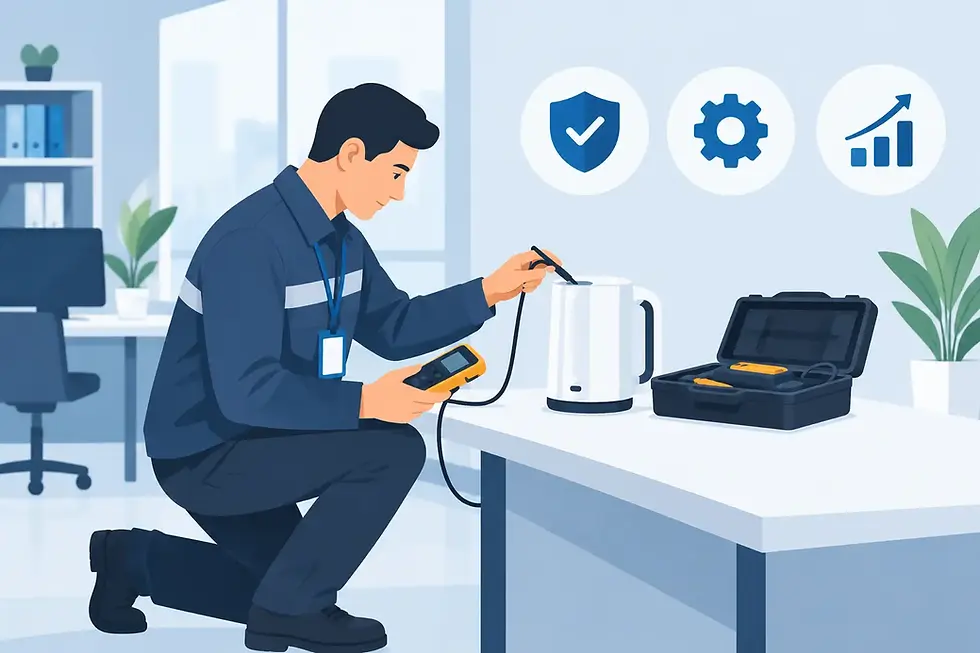
Formal visual inspection goes further. A competent tester examines plugs, fuses, cables, appliance casings and signs of damage or misuse. Electrical tests may then be carried out to check features such as earth continuity, insulation and polarity, depending on the appliance type.
This combination is what people usually mean by PAT testing. It is not a substitute for good day-to-day housekeeping. Equipment that is visibly unsafe should be taken out of service immediately, whether its next scheduled test is tomorrow or six months away.
The regulations do not set one testing frequency
Annual PAT testing is common, but it is not automatically the right interval for every appliance. Test frequency should be based on risk assessment and common sense.
Equipment used daily in a busy communal area, a care setting or a workshop is more likely to suffer wear than a monitor kept at one desk. Extension leads and multiway adaptors often deserve closer attention because they are moved, overloaded or damaged more easily. Handheld appliances, portable heaters, catering equipment and items used outdoors may also need more frequent inspection.
By contrast, equipment that rarely moves in a well-managed office may require less frequent electrical testing, supported by regular visual checks. New equipment may not need immediate PAT testing if it is supplied in good condition and is covered by the manufacturer's declaration of conformity, although it should still be visually checked before use.
A qualified PAT tester can help set realistic intervals that suit your premises, rather than applying a one-size-fits-all schedule. This can avoid both unnecessary cost and gaps in your safety arrangements.
Who is responsible for PAT testing?
Responsibility normally rests with the employer or person who controls the premises and equipment. In practice, this may be a business owner, office manager, facilities manager, school business manager, landlord or charity trustee.
You can appoint a competent external provider to carry out the work, but you cannot simply pass on responsibility and forget about it. You still need to make sure testing is suitable for your environment, failed items are dealt with and records are kept in an accessible place.
For landlords, the position needs particular care. Electrical safety rules for rented homes focus strongly on fixed electrical installations, such as consumer units, sockets and wiring. Portable appliances supplied as part of a tenancy must also be safe, but the appropriate inspection and testing regime can vary according to the property, tenancy type and the appliances provided. A proportionate record of checks is a sensible safeguard.
If you run a serviced office, community hall, nursery, healthcare practice or other public-facing site, consider equipment brought in by staff, tenants or visitors too. You may not own every item, but unmanaged personal appliances can still create a risk on your premises. A clear policy on personal heaters, chargers, extension leads and kitchen equipment is often helpful.
Do you need PAT certificates and labels?
The law does not prescribe one particular PAT certificate or label design. Nevertheless, clear reports and appliance labels make compliance much easier to manage.
A proper report should show what was tested, the result, test date, retest date where applicable and any faults found. It should enable you to identify each appliance without guesswork. Branded pass or fail labels give staff a quick visual reference, while the full report provides the detail needed for internal records, insurance enquiries, client audits or health and safety reviews.
Keep records of failed items too. A failure is not necessarily a problem if it was identified, removed from use and repaired or replaced promptly. The problem arises when unsafe equipment remains available for use, or there is no evidence that issues were acted on.
Good documentation is particularly useful after an incident or inspection. It demonstrates that you had a planned maintenance process, used a competent person and responded to defects. It does not guarantee that an accident can never happen, but it puts your organisation in a far stronger position than an undocumented approach.
What equipment should be included?
Portable appliances are generally items that plug into a mains socket or have a detachable lead. This can include computers and monitors, printers, kettles, microwaves, lamps, fans, extension leads, power adaptors, cleaning equipment, power tools and portable heaters.
Do not overlook leads and adaptors. An extension lead may look harmless, yet it is one of the items most likely to be subjected to strain and rough handling. Likewise, a laptop may be low risk, but its charger cable can become damaged through repeated travel or being caught in chair wheels.
Fixed electrical installations are different. Wall sockets, fixed wiring and consumer units require inspection under a separate electrical installation regime. PAT testing does not replace an Electrical Installation Condition Report. Most businesses need to consider both, according to their responsibilities and the condition of their premises.
A straightforward way to manage compliance
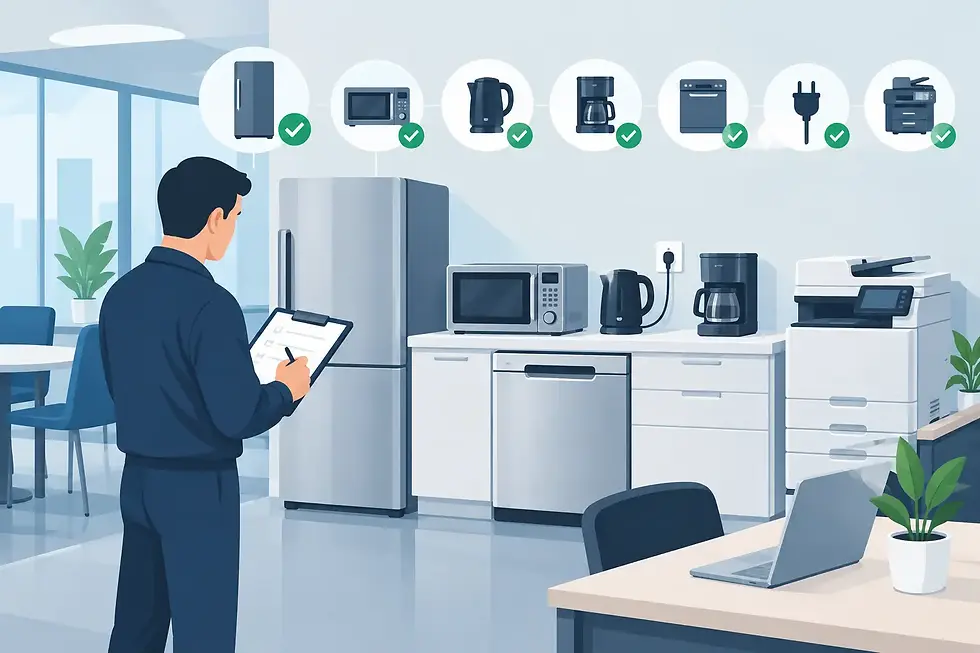
Start by making a practical list of the portable equipment your organisation owns or provides. Include shared kitchen items, meeting-room equipment, cleaners' appliances, extension leads and anything used away from a desk.
Next, consider where and how each item is used. High-use, mobile or harsh-environment equipment should generally be checked more often than low-use equipment in a controlled office. Make sure staff know how to report damage and that there is a clear process for quarantining failed appliances.
Finally, arrange testing at a time that causes minimal disruption. For businesses around Basingstoke, Reading, Fleet and Farnborough, out-of-hours PAT testing can be a useful option for offices, schools, surgeries and customer-facing premises that cannot easily pause normal operations. A qualified provider should leave you with clear, jargon-free reporting and a sensible plan for future testing dates.
PAT testing is not a legal box-ticking exercise with one universal deadline. It is a practical part of keeping people safe and showing that electrical risks are being managed. A clear testing programme, sensible intervals and reliable records give you confidence that a small fault does not become a much bigger problem.
Comments