

What a PAT Report Certificate Should Include

If someone asks for your PAT report certificate, they usually want more than proof that a few plugs were checked. They want clear evidence that your portable electrical equipment has been tested properly, the results have been recorded, and you have the paperwork to support your safety procedures. That matters whether you are dealing with an insurer, preparing for an audit, or simply trying to keep workplace records in good order.
For most businesses, the real value is not the certificate on its own. It is the full reporting behind it. A good PAT testing service should leave you with documentation that is easy to follow, easy to file, and easy to produce when someone asks for it. If the paperwork is confusing, incomplete or full of jargon, it creates more admin rather than less.
What is a PAT report certificate?
A PAT report certificate is the document set that confirms portable appliance testing has been carried out and records the outcome. Some providers use slightly different wording. One may refer to a certificate, another to a report, and another to a test schedule with certification. In practice, most customers mean the same thing: official documentation showing what was tested, when it was tested, and whether it passed or failed.
This is why it helps to think of the certificate as part of a wider reporting package. The certificate gives the formal record that testing took place. The report provides the detail behind it. Together, they support your compliance records and make it easier to show that electrical equipment is being managed sensibly.
For a business, school, charity, surgery or rented property, that documentation can be just as important as the testing itself. Without a proper record, it is harder to demonstrate due diligence.
Why the PAT report certificate matters
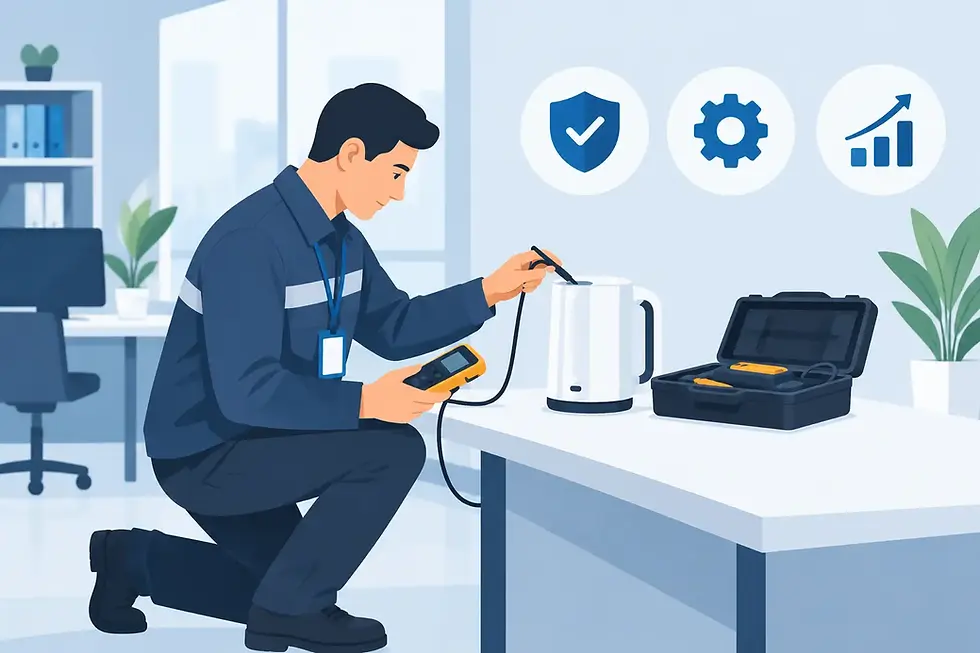
Portable Appliance Testing is not just a box-ticking exercise. It is one part of a sensible electrical safety process. If an item is damaged, incorrectly wired or no longer safe to use, the test helps identify that. The report then creates a trail showing what was found and what action was taken.
That record is useful in several situations. It helps with internal safety checks, especially where multiple staff use shared equipment. It helps during inspections or audits when someone wants evidence that appliances are being monitored. It can also support insurance records, because insurers may ask how electrical risks are being managed.
There is a practical side too. If you run an office, workshop, school or care setting, you probably do not want to sift through vague notes or handwritten labels to work out which kettle, monitor or extension lead was tested last year. Clear reporting saves time. It also reduces the risk of missed retesting dates or uncertainty over failed items.
What should a PAT report certificate include?
The exact format can vary, but a useful certificate and report should contain the basics in plain English. At minimum, you should expect the name and address of the site where testing was carried out, the date of the inspection and testing, and details of the company or technician who completed the work.
It should also identify the appliances tested. That normally includes an item description, asset number or unique reference, and often the location of the appliance within the building. This sounds simple, but it makes a big difference later. A report that says only "computer" is not much help if you have thirty of them across different rooms.
The results should be clear. Each appliance should be marked as pass or fail, with failed items recorded properly rather than quietly omitted. Good reporting will also note the reason for failure where relevant, such as visible damage, a wiring fault or an earth continuity issue. That gives you a practical next step instead of leaving you to guess what happened.
A certificate may also include the overall number of items tested, how many passed, how many failed and whether any items were removed from service. That headline view is useful for managers who want a quick overview without reading every line of the schedule.
PAT report certificate details that make life easier
The best paperwork does more than meet the minimum. It should make future admin easier.
One useful feature is clear appliance labelling that matches the report. When the labels on your equipment tie back to the documented asset list, it becomes much easier to identify each item, track repeat testing and avoid confusion. If a failed extension lead is listed on the report, you should be able to match it to the actual item without any detective work.
Another is a sensible retest recommendation. There is no single test interval that suits every workplace. A busy construction environment and a low-risk office do not present the same level of wear and tear. A worthwhile report reflects that reality instead of applying a blanket date to everything with a plug.
Jargon-free wording matters too. Most business owners and managers do not need a technical lecture. They need to know whether equipment is safe to remain in use, whether anything needs attention, and what records they should keep. Straightforward reporting makes that easier.
Certificate alone or full report?
This is where some confusion creeps in. A simple certificate may confirm that testing was carried out on a given date at a particular site. That can be useful, but on its own it is often not enough. If you need to prove which appliances were included and what happened to each one, you need the supporting report schedule as well.
For small sites with only a handful of appliances, a basic certificate may seem sufficient at first. But even then, full reporting tends to be the safer option. If an audit happens months later, or a member of staff asks whether a particular heater was tested, the detail becomes important.
For larger organisations, a certificate without a proper asset list is rarely enough. Offices, schools, landlords with multiple properties and businesses with mixed equipment all benefit from having the full picture.
What happens if an item fails?
A failed result should not be treated as a paperwork problem. It is a safety finding. The report should make that clear, and your provider should explain the result in plain language.
In many cases, the next step is straightforward. The item may need to be removed from use, repaired or replaced. Sometimes the issue is visible damage to a plug or cable. Sometimes it is an internal fault that only shows up during testing. Either way, the point of the report is to help you act on it quickly.
A good service will not leave you with a list of failures and no context. You should understand which items failed, why they failed where relevant, and what that means for your records. That keeps your workplace safer and avoids uncertainty for staff.
Choosing a provider for PAT testing and certification
If you are comparing providers, the testing itself is only part of the service. The quality of the PAT report certificate and reporting matters just as much.
Look for a provider that keeps the process straightforward, works around your operation where possible, and supplies documentation you can actually use. Out-of-hours appointments can be valuable if you need testing completed with minimal disruption. Clear pricing matters as well, especially if you are managing multiple sites or working to a facilities budget.
It is also worth checking whether the provider carries appropriate insurance and whether reports are presented in a way that suits your record-keeping. These details can seem minor until you need the paperwork quickly.
For businesses around Basingstoke, Reading, Fleet and nearby areas, local service can make a real difference. It often means faster response times, easier communication and more flexibility when appointments need to fit around staff, customers or site access.
Keeping your records current
Once your testing has been completed, the job is not quite finished. The certificate and report need to be stored properly and kept accessible. If different people manage health and safety, facilities or office administration, make sure they know where the records are held.
It also helps to keep track of when retesting is due. Renewal reminders can take some of that pressure away, particularly for busy organisations that do not want another compliance date to chase manually. The aim is simple: no last-minute scrambling, no missing paperwork, and no uncertainty about whether equipment records are up to date.
At Pax Animi PAT Testing, that practical side of the job matters just as much as the testing on the day. Businesses need a service that is competent, reliable and easy to deal with, backed up by reporting that makes sense.
When your PAT paperwork is clear, complete and easy to find, electrical safety feels far less like an admin burden and much more like it should - a straightforward part of running a responsible workplace.

Comments