

Office PAT Testing Compliance Guide for Employers
- A Swift
- 5 days ago
- 6 min read

A failed extension lead under a desk can look like a small maintenance issue. In a busy office, however, it can quickly become a safety concern, an insurance question and a gap in your workplace records. This office PAT testing compliance guide explains what employers and duty holders need to do, without turning a straightforward safety task into unnecessary paperwork.
PAT testing is one part of a sensible electrical safety process. Done properly, it helps you identify damaged or faulty portable equipment before it causes harm, while providing clear evidence that appliances have been checked and managed responsibly.
What PAT testing compliance means in an office
PAT stands for Portable Appliance Testing. It refers to the inspection and, where appropriate, electrical testing of portable electrical equipment. In an office, this may include laptops, monitors, desktop computers, chargers, printers, kettles, microwaves, fans, extension leads and docking stations.
There is no UK law that says every appliance must receive a PAT test every year. The legal duty is broader: employers, landlords and other responsible persons must make sure electrical equipment is maintained so that it is safe to use. This comes from the Electricity at Work Regulations 1989, alongside wider health and safety responsibilities.
That distinction matters. Compliance is not about applying the same testing date to every item regardless of its condition or use. It is about having a proportionate system that considers risk, identifies faults and keeps suitable records. For most offices, professional PAT testing gives the process structure and produces the documentation needed for internal procedures, insurers and audits.
Start with a practical equipment register
The first challenge is often knowing what equipment is on site. Offices accumulate appliances gradually: a personal phone charger appears in a meeting room, a heater is brought in during winter, or an old monitor remains connected in storage. If it is plugged into the mains and can be moved, it should be considered as part of your safety arrangements.
A useful equipment register records the appliance type, location, asset or serial number, owner where relevant, test result and next review date. Your PAT testing provider can usually create or update this register during the visit, rather than leaving your team to build one from scratch.
Do not overlook equipment supplied by staff. Employers may allow personal electrical items, but they should have a clear policy. Either prohibit them, require approval before use, or include them in the testing programme. The key is consistency. An untested personal heater presents the same potential risk as one bought by the business.
Include the items that are easy to miss
The most commonly missed office items are extension leads, multiway adaptors, laptop power supplies, desk fans and kitchen appliances. Extension leads deserve particular attention because they experience regular movement, can be overloaded and are often hidden behind furniture.
Low-voltage devices still need their mains leads and power supplies checked. A laptop itself may be low voltage, but its charger plugs into the mains and is often subject to bending, wear and accidental damage.
Use risk to set sensible testing intervals
Testing frequency depends on the equipment, the environment and how it is used. A desktop monitor in a clean, secure office is generally lower risk than a kettle in a shared kitchen or an extension lead used daily in a busy training room.
Visual inspections may be appropriate more often than formal electrical tests, particularly for equipment that is moved frequently. Staff can play a useful role here. They should know not to use an item with a damaged plug, exposed wiring, loose cable, scorch marks, cracked casing or signs of overheating.
As a general approach, fixed office equipment may need less frequent formal testing than portable equipment. Appliances used in kitchens, reception areas, workshops or public-facing spaces may justify closer attention. If equipment is hired, moved between sites or used in demanding conditions, its testing schedule may also need to be more frequent.
A qualified tester can help you set intervals that suit your premises and risk profile. This avoids two common problems: testing everything more often than necessary, or leaving higher-risk equipment unchecked for too long.
Office PAT testing compliance guide: what a visit involves
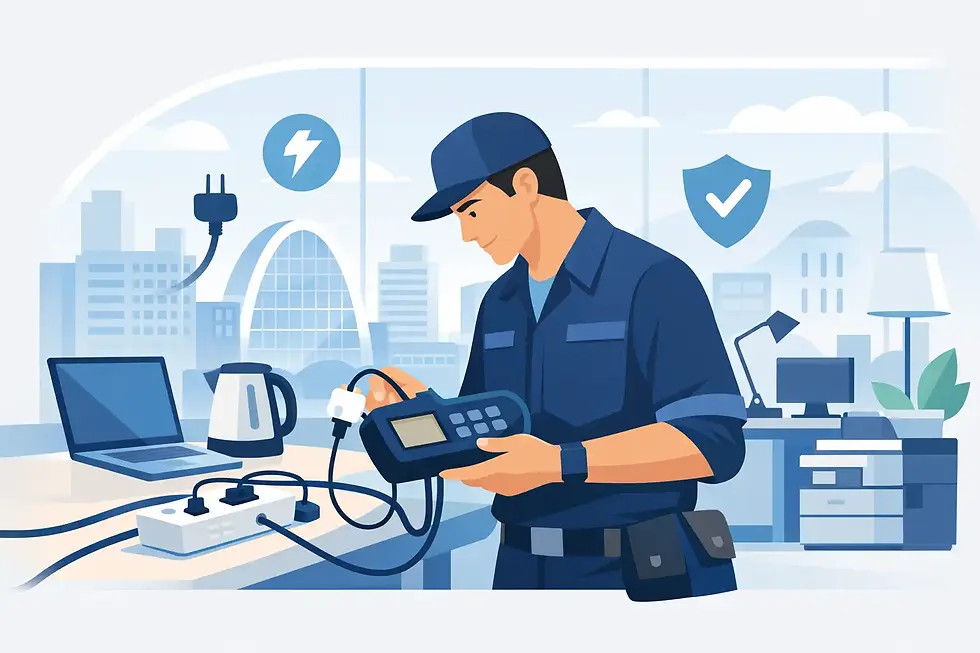
A professional PAT testing visit should be organised around your working day. The technician will normally carry out a visual inspection first, then use calibrated test equipment where required. Each appliance is recorded, labelled with its result and included in the final report.
A pass label makes it easy for staff to see that an item has been checked, but the certificate and report are the more important records. They should clearly show which items passed, failed or require attention, along with appliance descriptions and locations.
If an item fails, it should be removed from use or clearly marked until it has been repaired, replaced or retested. A failed item is not necessarily a major incident. Often the issue is a damaged plug, incorrect fuse, worn cable or faulty extension lead. What matters is that it is dealt with promptly and that the action is recorded.
For offices that cannot pause during normal hours, out-of-hours testing can be a practical option. It reduces interruptions to staff, avoids the need to unplug workstations in the middle of the day and allows kitchen or communal equipment to be checked without affecting daily routines.
Keep records that are useful, not just complete
Good compliance records should answer simple questions quickly: what was tested, where it was located, when it was checked, what the result was and what happened to failed equipment. They should be clear enough for an office manager to use, not only an electrical specialist.
Keep your latest PAT certificate and detailed report together with any repair records, equipment register and internal inspection notes. If an insurer, auditor or health and safety adviser asks for evidence, you can then show a clear process rather than searching through old emails and paper labels.
It is also wise to record new purchases as they arrive. Adding an appliance to the register at the point of purchase is easier than trying to identify every new charger and kitchen item at the next annual review.
Make responsibilities clear
One person should own the process, even if several people help with it. In a small business, that may be the owner or office manager. In a larger organisation, it may sit with facilities, health and safety or an appointed site representative.
Their role is not to become an electrician. It is to arrange testing, maintain the records, make sure failed items are not used and remind colleagues about the policy for personal appliances. Clear ownership prevents the usual problem of assuming someone else has dealt with it.
Common mistakes that create avoidable risk
The biggest mistake is treating PAT testing as a one-off certificate. Appliances change, staff move desks, and new equipment arrives throughout the year. Testing works best when it supports an ongoing process of inspection, record keeping and prompt action.
Another mistake is relying on labels alone. A label can fall off, become unreadable or be placed on the wrong appliance. Always retain the supporting report and certificate.
It is also worth avoiding blanket rules that do not reflect the workplace. An annual test for every single office item may be simple to administer, but it may not be the most proportionate approach. Equally, stretching intervals without considering usage, environment and condition can leave genuine risks unmanaged.
Finally, do not allow convenience to override safety. Overloaded adaptors, daisy-chained extension leads and temporary heaters under desks are warning signs that should be addressed, even where individual appliances have passed their tests.
Choosing a PAT testing provider
Look for a provider that can explain the process plainly, test with minimal disruption and supply complete, easy-to-read reporting. Ask what is included in the price, whether labels and certificates are provided, how failed items are reported and whether appointments are available outside office hours.
For businesses around Basingstoke, Reading, Fleet and Farnborough, Pax Animi PAT Testing provides qualified testing, branded appliance labels and jargon-free reports designed to make records easier to manage. Renewal reminders can also help prevent testing dates being missed as the year moves on.
The right service should save your team time, not create more administration. A clear quotation, professional testing and usable documentation are usually more valuable than the lowest headline price.
A well-run PAT testing programme gives you one less operational worry: staff can use their equipment with greater confidence, and you have clear evidence that electrical safety is being managed responsibly.


Comments