

Portable Appliance Testing Regulations Explained

If you are responsible for a workplace, school, rental property or public building, portable appliance testing regulations can feel more complicated than they need to be. Most people are not looking for a legal lecture. They just want to know what has to be tested, how often it needs doing, and what records they should keep so they can show they are taking electrical safety seriously.
The first thing to clear up is that there is no single UK law that says every portable appliance must have a PAT test every year. That is where a lot of confusion starts. In practice, the legal duty comes from wider health and safety rules that require electrical equipment to be maintained in a safe condition. PAT testing is one recognised way of helping businesses meet that duty, alongside visual checks, sensible record keeping and a risk-based approach.
What portable appliance testing regulations actually mean
When people talk about portable appliance testing regulations, they are usually referring to a group of legal responsibilities rather than one stand-alone regulation. For most businesses, the key point is simple: if staff, customers, tenants or visitors are using electrical equipment you provide, you have a duty to make sure it is safe.
That duty is commonly linked to legislation such as the Electricity at Work Regulations 1989 and the Health and Safety at Work etc. Act 1974. These place responsibility on employers, landlords and those in control of premises to prevent danger so far as reasonably practicable. Portable Appliance Testing supports that by identifying faults that may not be obvious during day-to-day use.
This matters because electrical risk is not always dramatic or visible. A kettle with a damaged lead, a photocopier with a loose plug, or a heater that has been knocked in storage may still work perfectly well while presenting a genuine hazard. Testing is not just about faulty items. It is about proving there is a sensible system in place.
Is PAT testing a legal requirement?
Strictly speaking, PAT testing itself is not named as a blanket legal requirement for every appliance in every setting. What is required is that electrical equipment is maintained safely. In many workplaces, PAT testing is the most practical and defensible way to show that this is being done properly.
That distinction matters. Some businesses hear that PAT testing is not specifically required and assume they can ignore it. Others are told every item must be tested annually, even where the risk is low. Neither approach is especially helpful.
A small office with low-risk equipment may not need the same testing schedule as a workshop, school, construction site or charity shop. The right approach depends on how the equipment is used, who uses it, how often it is moved, and the environment it is kept in. Portable items that are handled regularly or used in tougher conditions will usually need more frequent attention than equipment sitting undisturbed behind a desk.
Which appliances are covered?
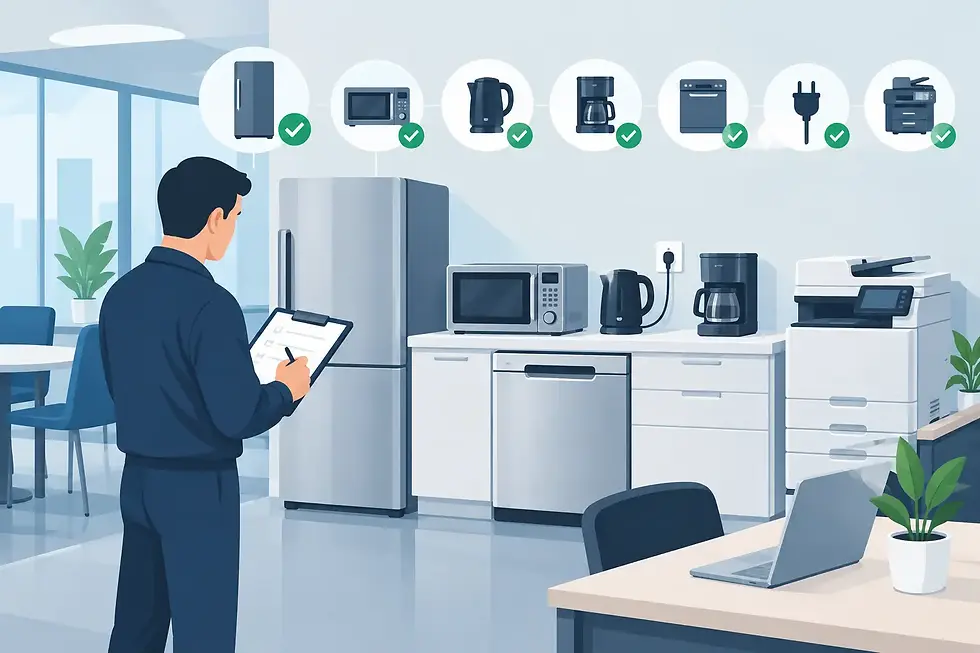
In plain terms, a portable appliance is any electrical item that can be moved and connected to the mains through a plug. That includes obvious items such as kettles, monitors, extension leads, printers, floor cleaners, fans, microwaves and portable heaters. It can also include IT equipment, chargers, desk lamps and some larger items that are movable even if they are not moved often.
Extension leads and adaptor blocks deserve special attention. They are heavily used, often overlooked and commonly damaged. In many workplaces, they are among the items most likely to fail inspection or testing.
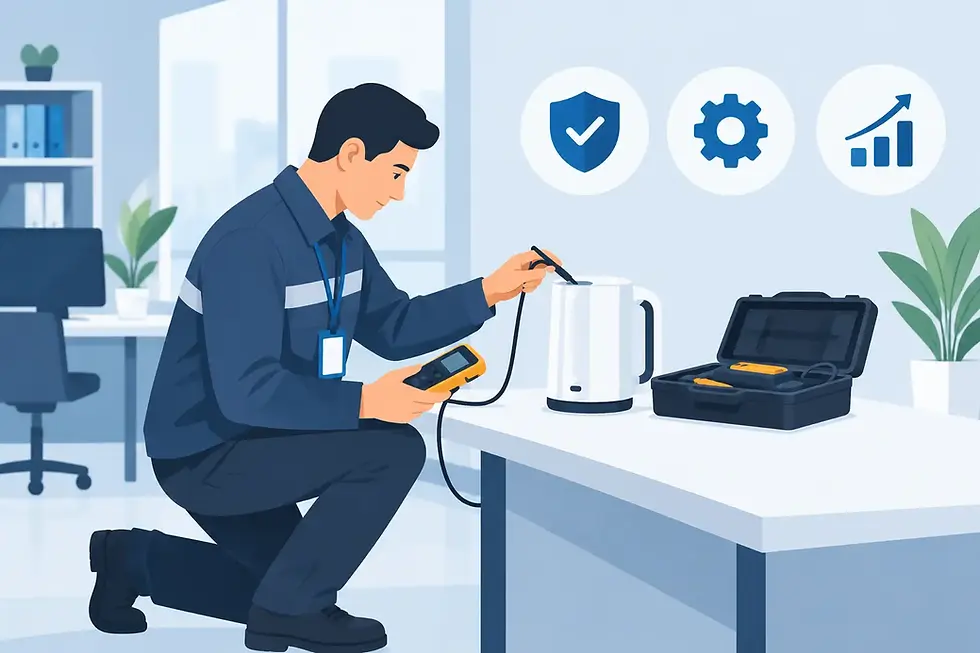
Not every appliance needs the same type of assessment. Sometimes a formal visual inspection is enough. In other cases, combined inspection and electrical testing is the better option. A qualified PAT technician should be able to explain what is appropriate without drowning you in technical terms.
How often should PAT testing be done?
This is one of the most common questions, and the honest answer is that it depends. There is no universal timetable that suits every business.
A low-risk office might need less frequent testing for desktop equipment if there is a good system for user checks and visual inspection. A busy workshop, kitchen, clinic or school usually needs a more regular schedule because equipment is used more intensively and is more likely to suffer wear or accidental damage.
A sensible testing frequency is usually based on risk factors such as:
the type of equipment
how often it is used
whether it is moved or handheld
the environment it is used in
the likelihood of damage
the type of people using it
This is why fixed annual testing is not always the perfect answer, even though many organisations choose it because it is simple to manage. A yearly programme can be practical for administration, budgeting and audit readiness, but it should still reflect the actual level of risk on site.
What businesses should keep on record
Good records are often just as important as the testing itself. If you are ever asked about your electrical safety process by an insurer, auditor, landlord, client or enforcing authority, you need to show more than good intentions.
At a minimum, you should be able to identify what equipment you have, what has been inspected or tested, when it was checked, what the result was, and what action was taken on any failures. Clear labelling helps staff identify whether an item has passed, failed or is due for review, but labels alone are not enough. The supporting report and certification matter too.
This is where clear, jargon-free documentation makes a real difference. If a report is too technical to understand, it becomes harder to act on it. Most organisations want records that are easy to file, easy to review and easy to produce when someone asks for evidence.
Who can carry out PAT testing?
PAT testing should be carried out by someone competent to do it. Competence means having the right knowledge, training and practical understanding of the equipment being inspected and tested.
For straightforward visual checks, in-house staff may sometimes be trained to help as part of an overall safety process. But for formal PAT testing, many organisations prefer to use a qualified specialist. That reduces the risk of missed faults, inconsistent records or uncertainty over what has actually been tested.
It also saves time. For busy offices, schools, landlords and facilities teams, the real value is not just the test itself. It is having the work completed efficiently, with minimal disruption, and receiving documentation that is ready for insurance records and compliance files.
Common mistakes around portable appliance testing regulations
The biggest mistake is treating PAT testing as a box-ticking exercise. If equipment is tested but damaged items are left in use, or no one follows up on failed appliances, the paperwork does not help much.
Another common issue is relying on an arbitrary schedule without considering risk. Testing everything too often can add unnecessary cost and disruption. Testing too little can leave obvious gaps. The better approach is a practical one based on the type of site and how appliances are actually used.
There is also the problem of poor record management. Businesses often know testing was done at some point, but cannot quickly find the report, the certificate or the failed item list. That becomes frustrating when audits, inspections or insurance renewals come around.
Making compliance simpler in practice
For most organisations, the aim is not to become experts in electrical regulations. It is to have a reliable system that keeps people safe and avoids avoidable hassle.
That usually means arranging testing at a time that suits the site, keeping disruption low, making sure all relevant items are included, and receiving clear documentation afterwards. Out-of-hours appointments can be particularly useful for workplaces that cannot afford downtime during the working day, such as surgeries, schools, hospitality settings and customer-facing offices.
If you operate across sites in places such as Basingstoke, Reading, Fleet or Farnborough, consistency matters even more. A standard process makes it easier to stay on top of renewal dates, keep records current and avoid missing equipment that moves between locations.
For many clients, that is the real benefit of using a specialist service such as Pax Animi PAT Testing. It turns a task that is easy to postpone into a straightforward part of routine compliance.
Portable appliance testing regulations do not need to be intimidating. What matters is having a sensible, documented process that matches your environment, your equipment and the level of risk. When testing is handled properly, it gives you something valuable beyond a pass label - confidence that your workplace is safer and your records are ready when you need them.
Comments