
Essential Appliance Safety Records to Keep

When an insurer, auditor or safety officer asks how you manage portable electrical equipment, a pile of pass stickers is not enough. Essential appliance safety records show what equipment you have, what was checked, what failed and what action was taken. Kept properly, they turn electrical safety from a last-minute concern into a clear, manageable routine.
For offices, schools, workshops, landlords, charities and healthcare settings, the aim is not to create paperwork for its own sake. It is to demonstrate that reasonable steps have been taken to prevent electric shock, fire and equipment-related incidents.
Why appliance safety records matter
Employers, duty holders and those responsible for premises have responsibilities under UK health and safety law to maintain electrical equipment in a safe condition. Portable Appliance Testing, commonly known as PAT testing, is one way of supporting that duty. It is not a legal requirement to test every item annually, nor is there a legal document called a PAT certificate that every business must hold.
What matters is having a sensible maintenance system based on the equipment, where it is used and who uses it. Good records provide evidence of that system. They also make it easier to identify repeat faults, plan retesting, respond to an incident and answer questions from insurers or clients without searching through old emails.
A record should tell a straightforward story: this appliance was identified, inspected or tested on this date, found safe or unsafe, and dealt with appropriately.
The essential appliance safety records to maintain
The best record-keeping system is the one your team can keep current. A small office may manage with a well-organised digital report and asset list. A larger site with several departments, or a landlord with multiple properties, may need a more detailed register. Either way, the following records form a practical foundation.
An appliance inventory or asset register
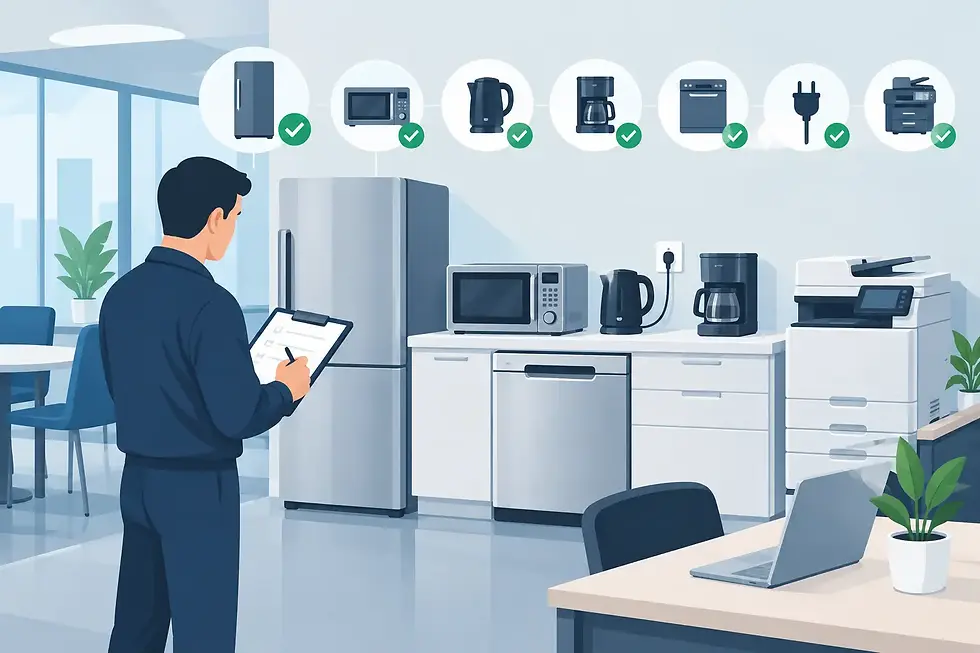
Start with a list of portable and movable electrical equipment under your control. This can include computers, monitors, extension leads, kettles, microwaves, printers, power tools, chargers and cleaning equipment. Do not overlook leads and adaptors, as these are often damaged through regular handling.
For each item, record a clear description, make or model where useful, location, asset number or label number, and the person or department responsible if relevant. Serial numbers are helpful for higher-value equipment, but they are not always necessary for every low-cost item.
A good register prevents two common problems: appliances being missed during testing and equipment appearing in a report with no clear way to locate it. Branded appliance labels, matched to a report, make this much simpler on busy sites.
Inspection and PAT testing reports
A professional PAT testing report should show more than a simple pass or fail. It should identify the appliance, its location or asset number, the date of inspection, the tests carried out and the result. It should also record the next recommended inspection date where this forms part of the maintenance plan.
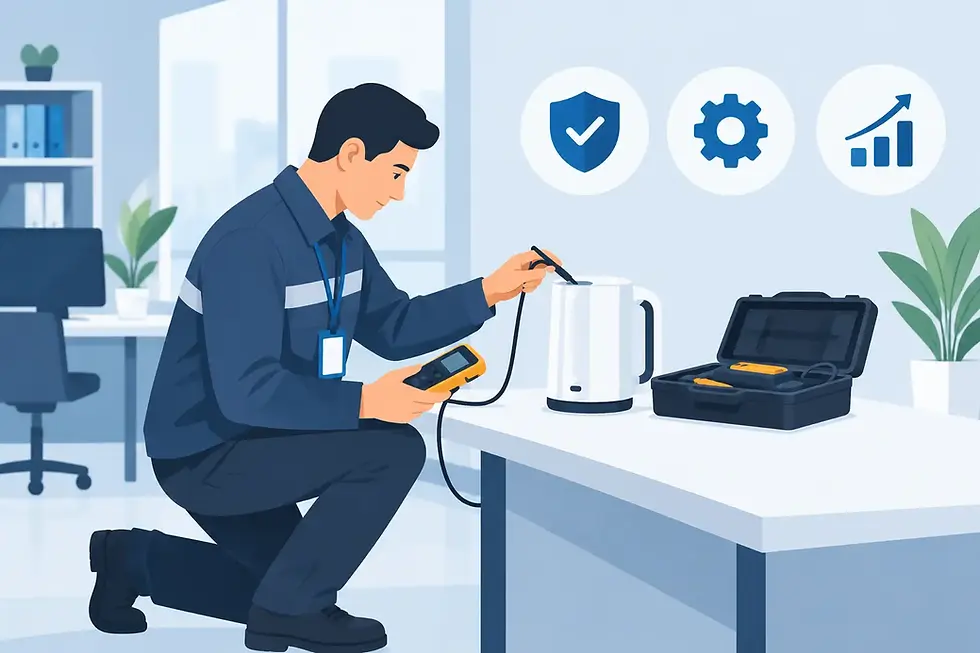
Visual inspection is a major part of electrical safety. Many faults are visible, such as a split cable, damaged plug, loose connection, burn marks or an unsuitable extension lead. Electrical tests can then be selected according to the type of appliance and its construction.
Clear reports are particularly valuable when equipment is moved between rooms or sites. If a staff member asks whether a particular projector, heater or drill has been checked, you should be able to find the answer quickly.
Failed-item and remedial-action records
A failed appliance should be removed from use promptly, clearly identified and either repaired, replaced or disposed of. The record needs to show what happened next. A test result marked fail is only half the process if the faulty item remains available for someone to plug in.
Keep a note of the fault, the action taken, the repairer if applicable, and the date the item was retested before returning to service. This is especially useful for equipment with recurring issues, such as heavily used extension leads, kitchen appliances or workshop tools.
There is a practical judgement involved. A damaged £10 lead may be safer and more economical to replace than repair. A specialist piece of equipment may justify repair and a documented retest. The important point is that the decision is recorded and the equipment is not put back into use until it is safe.
Risk assessment and testing-frequency decisions
There is no universal retest interval that suits every workplace. A desktop computer in a low-risk office is used very differently from a power tool on a building site, a hairdryer in supported accommodation or a kettle in a communal kitchen.
Your records should explain the approach you have chosen. Consider the type of equipment, its class, the environment, how often it is moved, the likelihood of damage and the people using it. Higher-risk or frequently handled equipment may need more frequent inspection. Lower-risk, stationary equipment may need a less frequent programme.
This does not need to be a lengthy technical document. A short, sensible record of the reasoning behind your inspection schedule is often enough, provided it is reviewed when circumstances change.
Repairs, replacements and alterations
Keep records for repairs that affect electrical safety, including replacement plugs, cables, chargers, fuses and power supplies. If equipment has been modified, moved into a harsher environment or returned after repair, it may require a further inspection or test.
These records help prevent assumptions. A pass result from last year does not automatically cover an appliance whose cable was replaced last week.
Staff checks and reported defects
Staff do not need electrical qualifications to notice obvious damage. A simple process for reporting loose plugs, damaged leads, overheating, unusual noises or intermittent power can prevent a minor issue becoming a serious incident.
Record reported defects and the action taken, particularly where an item is removed from service. For organisations with several employees or shared spaces, this provides a useful link between day-to-day checks and formal PAT testing.
How long should you keep PAT testing records?
There is no single legal retention period for PAT testing records. The sensible approach is to retain reports long enough to show an ongoing maintenance history and support your current risk assessment. Many organisations keep the current report plus previous reports for several years, particularly where they have insurance, contractual or internal audit requirements.
Your circumstances may justify longer retention. Schools, healthcare practices, landlords and organisations working under client contracts can have their own policies or sector-specific expectations. If an incident, claim or investigation arises, historical records may become relevant.
Digital reports are usually the easiest option. They are simpler to search, share and protect than paper folders, provided access is controlled and files are backed up. Keep the asset register and latest testing report together, rather than storing them in separate places that only one former employee understands.
Common record-keeping gaps to avoid
The most frequent issue is relying solely on a label. A pass label gives a useful at-a-glance indication, but it can fall off, fade or be attached to the wrong item. The detailed report is the supporting record.
Another gap is failing to update records when equipment arrives or leaves. New items brought in by staff, donated appliances, hired equipment and equipment moved from another site can easily fall outside the normal testing cycle. Include a simple check as part of purchasing, onboarding or site-move procedures.
It is also worth setting out who owns personal electrical equipment. If staff are permitted to use personal chargers, fans or heaters at work, decide whether they must be declared and inspected before use. A clear policy avoids uncertainty and helps keep the asset list meaningful.
Making compliance easier to manage
The most effective system is usually simple: maintain an asset list, arrange testing around your operating hours, act on failures immediately and store the report where the right people can access it. Renewal reminders then help ensure testing does not become an urgent task just before an audit or insurance renewal.
For businesses across Basingstoke, Reading, Fleet and the surrounding area, a qualified PAT testing service can reduce both disruption and administration. Pax Animi PAT Testing provides clear, jargon-free reporting and appliance labelling so that records are useful after the technician has left, not just on the day of testing.
Set aside a short time after each testing visit to check failed items, update your register and confirm the next review date. That small routine gives you a clearer picture of your equipment and helps keep everyone using it safer.
Comments